Thứ Tư, 14 tháng 1, 2015

Cao Lanh travel guide

West of Cai Be and My Tho, Highway 1 passes through the My Thuan Bridge on its way to Can Tho and Vinh Long. Just before reaching the bridge, at An Huu, Highway 30 heads north, passing through Cao Lanh after 34 km. The sleepy town provides little in terms of attractions and entertainment, unless you are enthralled with watching wading birds. The town is situated west of the Plain of Reeds, making it the perfect location for boat trips to see the cranes and storks near the swamplands. From Ho Chi Minh City, you’ll see the two large concrete tusks (resembling lotus petals) of the war memorial as you enter Nguyen Hue. One tusk bears the Vietnamese red star, while the other a sickle and hammer. Mekong river tours

There is a myth behind the name Cao Lanh. Once upon a time, there was a husband and wife name Lanh, came here from the middle part of Vietnam. Due to being straightforward and upright, he was promoted to be the legal representative men of the localities. Till 1820, the cholera spread out and many locals died. At that time, there was no medicines and medical measures, so people thought this epidemic is a punishment coming from God. Mr.Lanh also thought like that and he created an altar to pray to stop the disease. His wife, Mrs. Lanh was also infected and died in one day. After that, he was also infected and went in peace. The villagers then inhumed them right before the disappearance of the cholera. To memorize Mr. Lanh and his wife, the villagers called the market Cau Lanh. The name Cao Lanh as we know like nowadays is just another sound of Cau Lanh. When in Cao Lanh, there are some prominent sites and interesting things that you can’t ignore. The first is the Nguyen Sinh Sac Complex. With an area of 3.6 hectares, this complex includes two parts, the Grave and the Memorable House with stilted house and fish pond. The second one is a dish with rats, the roasted rat meat. The Cao Lanh Rat Meat is very famous in the South Vietnam. Coming here without tasting rat meat means that you have lost one third of interesting things of the tour package.
Cao Lanh travel guide

What to see?
When in Cao Lanh, visitors can visit the Nguyen Sinh Sac Complex that honors Ho Chi Minh’s father including the Grave and the Memorable House with stilted house and fish pond in an area of 3.6 hectares. Another very interesting thing in Cao Lanh is its Roasted Rat Meat, which is very famous in the South Vietnam. Nature lovers will certainly enjoy the bird sanctuaries and the Tram Forest (Rung Tram) here.  South Vietnam tours

Travel Tips Visiting Cao Lanh
Cao Lanh is a few hours by bus from Ho Chi Minh City via highways 1 and 30. The bus station is right in town.
Visitors should be aware with the insects such as mosquito

Thứ Tư, 7 tháng 1, 2015

The Muong group and their typical culture

The Muong have a population of around 1 million who live mainly in northern provinces like Hoa Binh and Thanh Hoa. The Muong culture is related to Hoa Binh culture dating back more than 10,000 years.
The Muong share ethnic roots with the Vietnamese people and their language is classified in the Vietnamese – Muong language branch. The Muong live in mountainous areas which have abundant land for growing wet rice. In a Muong hamlet, stilt houses shelter in the shade of big trees, huddle against the mountain, and look out on vast rice fields. A Muong house is designed to maximize convenient use and air ventilation to counter the warm, humid mountain climate. Sapa Vietnam tours
The Muong’s costume is special. Men often wear a round-neck shirt which opens in the front and has two pockets. Their pants have large trouser legs. On special occasions, the Muong men wear a purple or yellow silk shirt inside a long, white ceremonial robe. Quach Van Suong of Vo Do hamlet, Nhan Nghia commune, Hoa Binh, said: “When we were small our elders taught us the typical cultural features of our group reflected in our costume. We like to wear our traditional clothes every day as well as at festivals. It’s a way to preserve our culture for our children.”3 days to the Floating Markets 
The Muong women wear a long, black dress and a white or brown shirt with a line of buttons in the front and long sleeves. They wind a white or indigo headscarf around their head. The highlights of the Muong costume are embroidery on the dress hem and belt. It requires skill and artistic talent to design the patterns and harmonize the colors of the costume. Quach Thi Lan of Nhan Nghia commune says there are 40 popular patterns, of which the dragon is the favorite image. “The most important step in weaving a dragon is to count the threads used to make the dragon head, wings, and body. We have to consider the position of each part and mix white, black, and red to make a soaring dragon.”best cruises in Halong Bay
The Muong group and their typical culture

The Muong women in Hoa Binh play gong in leisure time

Drinking "ruou can" is a custom in many ceremonies of the Muong
The Muong have diverse folk arts including folk songs and poems, sorcerer’s worshiping songs, tales, proverbs, lullabies, and riddle songs. The gong is the most popular musical instrument along with the flute, the two-string violin, the drum, and the panpipe. Bui Thi Xuan, a member of the Club for preserving the Muong culture in Luc Doi hamlet, said the Muong have folk songs for every event such as a house warming, duet singing in the spring, and long epics. “The Club is collecting old songs to teach the children. Young people learn songs to sing during daily activities or at a wedding ceremony. When I was young, we worked and sang songs all the time.”

Thứ Sáu, 2 tháng 1, 2015

About Huong Hai Ha Long

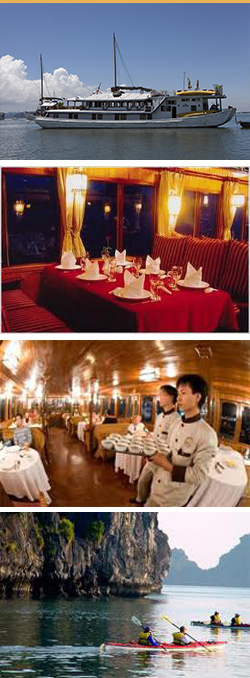
For more than 10 years in serving and hosting international guests on the tranquil waters of the bay, we do set a well-known, leading and stable standard of the best quality service for Ha Long Bay cruise trip from mid-range to high-range customer. The first and biggest company to offer overnight cruises on the bay,
Huong Hai understands customers’ desire and we built the first  traditional style wooden boat with deluxe deluxe cabins and facilities. As a result, nearly half of 1 million people have joined Huong Hai Junks on magical, enlightening journeys through Ha Long Bay,  Huong Hai cruise.

Beside the wooden traditional boat fleet with 6 boats named Huong Hai Junks, Huong Hai Ha Long proudly to grand open new luxury cruise named Huong Hai Sealife Cruises. The new boat inherits the experience of cruise service over the years and set a new standard of luxury cruising.

Grand Halong hotel on Halong bay Travelling Tour

About Huong Hai Ha Long

The first responsibility is to passengers and partners. Its products and services must always be of the best quality in 3-star standard. And bookings must be promptly attended too. Its trade channels buyers must make a fair profit.

Lost in the maze of Halong Bay caves


The second responsibility is to those who work with us, they must have a sense of security in their jobs. Wages must be fair and adequate. Management is just, hours reasonable and working condition nurturing. Captains & Supervisors are qualified and fair minded. Each crew member must be considered an individual, standing on his own dignity & merit.

The third responsibility is to Management. Our executive must be person of talent, education, experience and ability. They must possess common sense and full understanding.
The fourth responsibility is to the local communities and authorities. We will support environmental friendly project and local charity. We promote civic improvements, health, education, invest back into the local communities and make them part of the development of responsible Tourism.

Thứ Tư, 24 tháng 12, 2014

Christmas in Vietnam

Christmas is one of the four most important festivals of the Vietnamese year, including the birthday of Buddha, the New Year and the Mid-autumn Festival. Although the Christians observed the religious rituals of Christmas.

Traditional Vietnamese religions are Buddhism and the Chinese philosophies of Taoism and Confucianism. However, during French rule, many people became Christians, that occupy 8 to 10 percent of whose population. This is because the Vietnamese are a fun-loving, sociable people and the various Vietnam festivals and events are actually occasions for them to a gala time, all together. Christmas in Vietnam is a grand party. Tours to Vietnam

History Of Christmas In Vietnam

Christmas in Vietnam has had a tumultuous history. The Catholics are a minority in Vietnam but they used to celebrate Christmas in Vietnam quite in peace right from the days of the French rule. That is until the Communists took over political power in 1975. The church-state relations soured during that time and the Catholics were relegated to celebrating Jesus’s birthday in privacy.

Hoi an, a peaceful meeting place


Since the end of the Vietnam War in 1975, church-state relations have not always been smooth. However, they have been improving since the introduction of economic reforms in the late 1980s. Liberalist policies adopted since the 1980s saw Vietnam warming up to western influences and ideals and Christmas in Vietnam came back triumphantly. Now Christmas is one of the major festivals in Vietnam, celebrated with much fanfare by all religious communities. top 3 must see tourist attractions in Can Tho
Christmas in Vietnam

Phat Diem Cathedral in Ninh Binh Province is considered the spiritual home for the seven million Catholics who live in Vietnam, a predominantly Buddhist nation. Hundreds of Catholics gather for Christmas Eve Mass in the northern city of Phat Diem. Children staged a nativity play to celebrate the birth of Jesus Christ - or Kito, as he is known in Vietnamese -- in front of the city's cathedral, built in 1891.

Christmas In Vietnam

Christmas in Vietnam is a huge event, especially in Ho Chi Minh City, Vietnam and the Vietnamese Christmas celebrations here are like any other city in the western world. The Christians in Vietnam attend a Midnight mass on Christmas Eve and return home to a sumptuous Christmas dinner. The Christmas dinner usually consists of chicken soup while wealthier people eat turkey and Christmas pudding.Christmas tree at Fortuna Hotel (Hanoi)
Christmas tree at Fortuna Hotel (Hanoi)


On Christmas Eve, Vietnamese people in Hanoi and Ho Chi Minh City, especially young people, like to go into the city centre, where there is a Catholic Cathedral. The streets are crowded with people on Christmas Eve and in the city centre cars are not allowed for the night.

People celebrate by throwing confetti, taking pictures and enjoying the Christmas decorations and lights of big hotels and department stores. Lots of cafes and restaurants are open for people to enjoy a snack!

Vietnam used to be part of the French Empire and there are still French influences in the Christmas traditions. Many Catholic churches have a big nativity crib scene or 'creche' with nearly life size statues of Mary, Joesph, baby Jesus, the shepherds and animals. In some areas of Ho Chi Minh City, usually in Catholic parishes, people have big crib scenes in front of their houses and decorate the whole street, turning it into a Christmas area! These are popular for people to visit and look at the scenes.

Also like in France, the special Christmas Eve meal is called 'reveillon' and has a 'bûche de Noël' (a chocolate cake in the shape of a log) for desert. Vietnamese people like to give presents of food and at Christmas a bûche de Noël is a popular gift. Other Christmas presents are not very common, although some young people like to exchange Christmas cards.

The Yuletide spirit of giving and sharing has been embraced with an earnest by the Vietnamese. Generous as they are, the Vietnamese give out gifts and presents in plenty during the Christmas celebrations in Vietnam. However, the children are more keen to have their stockings and shoes stuffed in with goodies from Santa’s bulging sack. The European customs of Santa Claus and the Christmas tree were popular and children would leave their shoes out on Christmas Eve.

Merry Christmas in Vietnamese is “Chúc Mừng Giáng Sinh”!

Thứ Tư, 17 tháng 12, 2014

Kate Festival

Time: From the 30th day of the 6th month to 2nd day of the 7th month according to Cham calendar (around at the end of September and the beginning of October according to solar calendar).
Place: Po Inu Nagar Temple, Po Klong Garai Tower, Po Rome Tower (Ninh Thuan Province)
Objects of worship: Goddess Po Inu Nagar, King Po Klong Garai and King Po Rome.
Characteristics: Ritual of the Cham people. Mekong river tours

Kate Festival is the most unique festival of the Cham people. It associates with ancient towers where values of Cham culture are stored and other cultural aspects such as offerings, costumes, music instruments and hymns praising kings who made great service to the Champa Kingdom and Cham people. The festival is also an occasion for the participants to enjoy traditional arts performances of Cham people such as Apsara dance, Ginang and Paranung drum-beat, Saranai trump...
Kate Festival

The first day is for the ritual of receiving Goddess Po Inu Nagar's costume at Po Inu Nagar Temple in Huu Duc Hamlet, Phuoc Huu Commune, Ninh Phuoc District. Legend has it that Ra Glai people are Cham people's brother. Whenever upheavals come, kings of Cham people leave their country to seek refuge and commit their royal costumes to the Ra Glai people. Therefore, at the Kate Festival every year, the Cham people have to do a ritual to welcome and receive the costumes from the Ra Glai people. In the afternoon, the Ra Glai people in Tra No Hamlet, Phuoc Ha Commune, Thuan Nam District, Ninh Thuan Province bring costume of Goddess Po Inu Nagar to Cham people. The ritual of receiving Goddess Po Inu Nagar's costume is held first because Cham people consider Po Inu Nagar as ancestress of the Cham people. She taught local people to grow rice, plant cotton, weave clothing...

The second day (main festival day) is for Kate Festival at Po Inu Nagar Temple, Po Klong Garai Tower and Po Rome Tower. The festival takes place in three areas at the same time. In the early morning, the Ra Glai people in Phuoc Dong Hamlet, Phuoc Hau Commune, Ninh Phuoc District arrive at Po Klong Garai Tower in Do Vinh Ward, Phan Rang - Thap Cham City to hand King Po Klong Garai's costume over to the Cham people. When the procession arrives at the tower, a group of dancers will perform a welcome dance in front of the tower. After that, the ritual to ask permission of God Siva to open tower's door is held. The offerings include wine, egg, betel and areca, water mixed with aloe wood. The following rituals are bath and wear for the statue of King Po Klong Garai. Finally, a man (Kadhar) sings hymns to invite over 20 gods to attend great ritual. At the same time, participants pray the gods for health, happiness, abundant crop... The great ritual ends with a dance of ba bong (Muk Pay'u).

The similar rituals are also held at Po Inu Nagar Temple and Po Rome Tower in Hau Sanh Hamlet, Phuoc Huu Commune, Ninh Phuoc District.

The third day is for Kate Festival at Cham villages. Each Cham village worships its own God. In the morning, the ritual of worshipping God is held to pray for health, happiness, abundant crop... The offerings include 2 chickens, 5 trays of food, banh tet (cylindrical glutinous rice cake), fruits...  During the festival, many cultural activities and games are held, such as competitions of weaving, carrying water jar on one's head, football, singing.le bring breakfast to monks and listen to the sermon. At noon, they burn the lamps, offer sacrifice gifts and bring fragrant water to bathe Buddha statues. After the ceremony at the temple, the monks go to the grave to pray for the souls of those who died. Then they go home and do Buddha bathing ceremony at their own home in order to receive forgiveness for the mistakes in the previous year.

Thứ Sáu, 5 tháng 12, 2014

Hue Festival

Hue Festival is a big cultural event of Hue City that is held every two years. There is a week (usually in April, May or June) for each festival season which is the occasion to honor cultural and historical values of that Vietnam's former capital city. The first Hue Festival took place in 2000. Centre Vietnam tours

At the beginning of Hue Festival, visitors can enjoy a colorful and grand opening ceremony with unique performances of several art groups from Vietnam and other countries. Hue Festival has become a space of cultural exchange between peoples all over the world. During the festival, there are variety of cultural events taking place such as Hue Poetry Festival, Massive Street Arts Performances, the Dialogue of drums and percussion instruments, Art Exhibitions, the Week of Vietnam’s historical films.

Danang – Hue – Hoian 4 days

Hue Festival
Hue Festival

Otherwise, visitors can come and explore some traditional values of Vietnam at Gastronomy Quarters, Traditional Kite Flying Festival or watch “Ao dai” Grand Show, “Oriental night” Show, and sporting activities like boat race, human chess, etc. Especially, many ancient scenery of Nguyen Dynasty are also reproduced and provide tourists an insight into Vietnam’s feudal era. Some typical events include Nam Giao Offering Ritual, Xa Tac Offering Ritual, the Royal Refined Music of Hue which was recognized as a Masterpiece of the Oral and Intangible Heritage of Humanity by UNESCO in 2003. Hue Festival is well-known as an international festival where cultures of many countries converge together as well as where Vietnamese traditional and cultural values are widely presented to the world.

Thứ Tư, 26 tháng 11, 2014

Cultural villages in Sapa

Cat Cat village:

Located 2 km from Sapa Townlet, Sapa District, Cat Cat is the village of H'Mong ethnic groups. There remain heaps of unique customs and practices of people here, one of which is the brocade weaving craft. After being woven, pieces of brocades featuring beautiful designs will be dyed and embroidered. And then brocade fabrics are polished by rolling with a round section of wood covered with wax in order to keep their colors durable. Besides, residents here are skilled at manipulating gold and silver jewelry which is graceful and can be purchased in the village and in other travel places in Sapa.Travel to Sapa
Cultural villages in Sapa
Cultural villages in Sapa 

H'Mong ethnic people still maintain their traditional custom of "pulling wife" which has made particular impressions on many tourists. When a man falls in love with a girl in the village, he can ask his friends to unexpectedly lure that girl into his house and keep her there for 3 days. After these days, the girl can either agree to become his wife or freely go home if she doesn't like him. In case she agrees, an wedding which usually happens from two to seven days will be officially held.

The old-age Cat Cat village with its special culture has drawn many visitors to come and discover.

Ta Phin village:

Ta Phin village can be reached by thirty minute drive North of Sapa. It is the living place of the Red Dao and Black Hmong people.

In addition to luscious scenery and distinctive culture, Ta Phin village is especially well known for its famous brocade. Main brocade products created by the skillful hand of women here are backpacks, handbags, handkerchiefs, wallets, overcoats, etc, all of which are decorated with sophisticated colorful designs of flowers, birds. As for ethnic people, brocade is not only for beautifying but for symbolizing love.

Ta Phin village's brocade has become the indispensable gift for tourists once coming here. Impressive designs on those products showing ethnic groups' special culture helps distinguish them from brocade in other places and become the distinctive feature attracting visitors everywhere.

Hanoi & Sapa Homestay 6 days


Sin Chai village:

Sin Chai village, located at the foot of Fansipan Mountain, is 30km trekking from Sapa town. It is the village of the Dao ethnic people.

Visiting the village will be a terrific chance for tourists to enjoy stunning landscapes as well as discover culture of residents. What makes this community village special lies in local people who will take the time to teach textile weaving and dying and to explain names and function of the local flora. There are also many interesting activities relating to traditional sports, tree planting for visitors to take part in.

If you travelled to Sapa, trekking to such cultural villages as Cat Cat village, Ta Phin village, Sin Chai village, etc would leave you unforgettable memories.