Thứ Tư, 20 tháng 7, 2016

Saying hello and good-bye in Cambodia

Saying hello and good-bye in Cambodia
How to greet in Cambodia: The five versions of performing Sampeah
Sampeah (in Khmer: សំពះ)is the Cambodian way to greet and has five different steps to show the respect to another person. In this article, we show you how to perform Sampeah.
Sampeah is either used when you want to greet (in Khmer: ជំរាបសួរ -> joom reab sour) somebody or when you want to say goodbye (in Khmer: ជំរាបលា -> joom reab lea). First of all, we need to place our both palms together like a lotus flower in front of our chest. Both are the formal way to greet and to say goodbye. Indochina tours Cambodia
Saying hello and good-bye in Cambodia
One of the first things you should do is learn how to give a proper Cambodian hello.
In Cambodia social interactions are usually governed by centuries-old traditions of respect and hierarchy that may not be immediately obvious to the average expat. This is evident every time Cambodians greet you or each other. Cambodia travel tours
Cambodian hello
Learn how to say hello in Cambodia using the traditional sampeah.
20saying-hello-in-cambodian
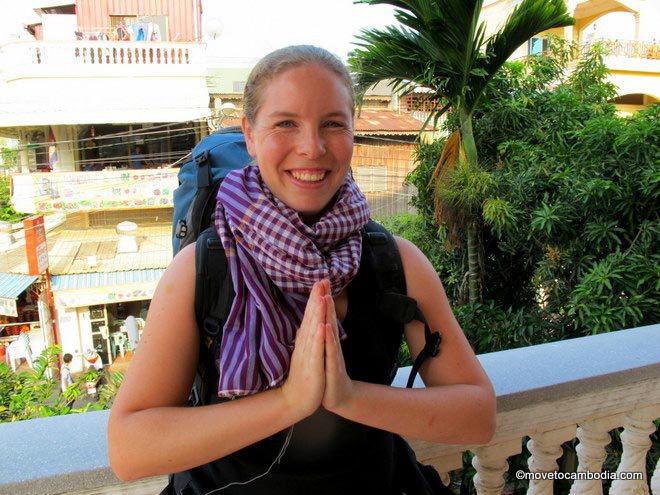
The traditional Cambodian way to say hello and good-bye is to place the hands together, with the palms touching (a posture Westerners often associate with praying), and bow the head. Similar to the Thai wai, this is called the sampeah, and it is how Cambodians greet one another, particularly for the first time. The formal greeting in Khmer is “Choum reap sor” and should be said while sampeahing. (The more informal “Susaday” is reserved for casual situations and does not involve a sampeah.) “Choum reap lear” is the formal good-bye.
Where you place the sampeah in front of your body depends on the age and relationship of the person you are greeting. The higher your sampeah, and the lower your bow, the more respect you are showing.
When you greet people of the same age and social standing as yourself, put your hands together in front of your chest and bob your head. When you greet your boss, older people, or those to whom you would like to show respect, your sampeah should be positioned so that your fingertips are just below your mouth. Parents, older relatives, and teachers should be greeted with the sampeah at nose level. Eyebrow-level sampeahs are reserved for monks and the king, and forehead-level sampeahs are exclusively for prayer, sacred sites, and temple worship.
Many foreigners, in an attempt to be polite, overenthusiastically sampeah, offering monk-level greetings to waitresses at local restaurants. This can actually be seen to cause a loss of face, so make sure you keep your sampeahs at appropriate levels. Traditionally, Cambodians do not sampeah to children, street vendors, and beggars; in these cases the polite response to a greeting is to do no more than nod and smile.

Thứ Năm, 7 tháng 7, 2016

Culture in Mekong delta


CULTURE OF RIVERS IN MEKONG DELTA
In addition, talking about Mekong Delta without mentioning the influence of Mekong River on the culture here is such a shortcoming. Hundreds year of inhabiting and make living on the branches of Mekong River has formed a characterized culture. Mekong river cruise Vietnam
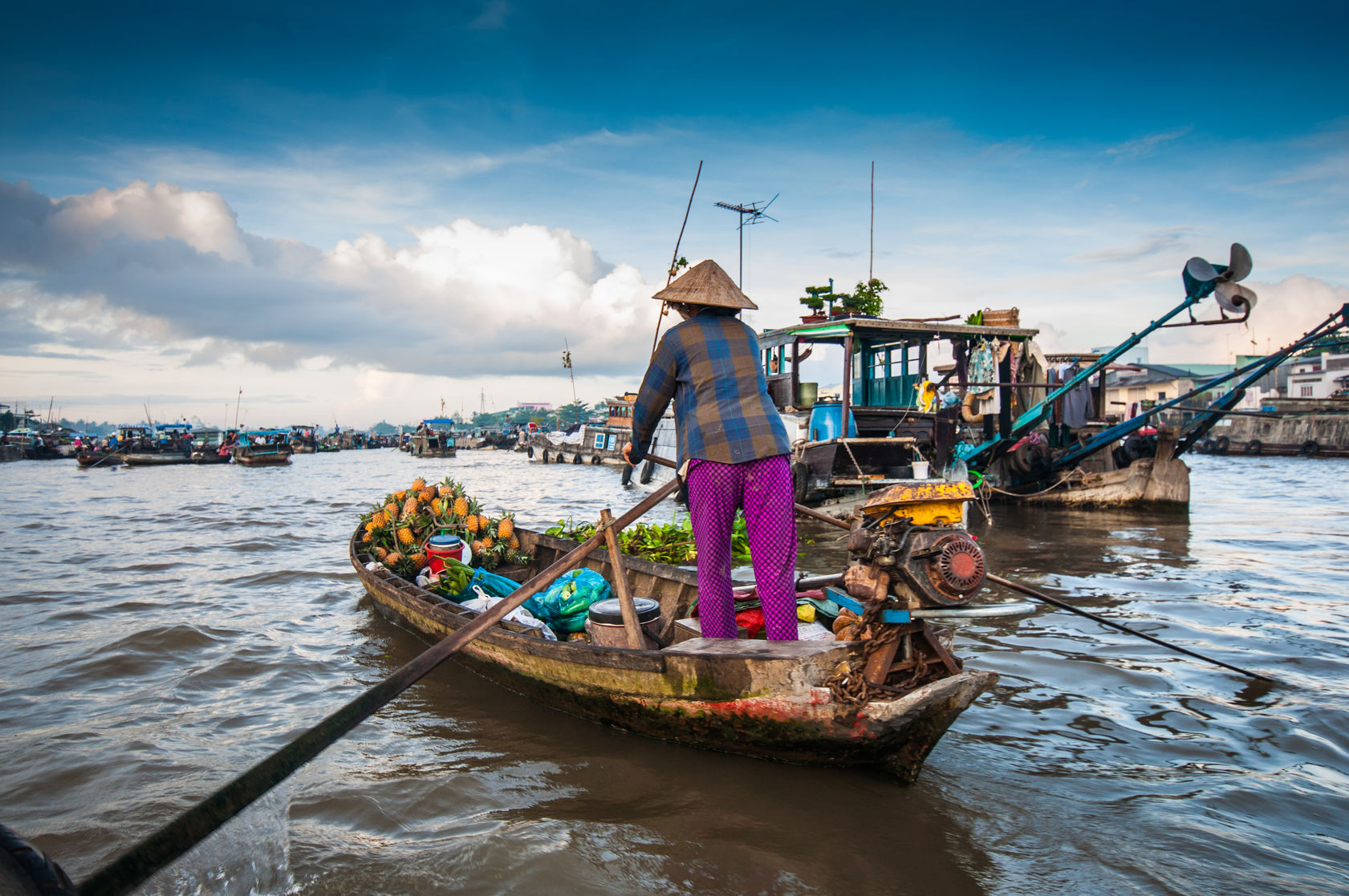
Thanks to the complex system of channels, transportation by the waterway is very popular. The common scenery of Mekong Delta is boats or junks travelling along the narrow canals flanked by dense row of mangrove. Together with canals all around the Mekong Delta, it is easy to catch up the image of rope bridges. These bridges appear in many folk-songs about its rough and difficulty to move on. Branches of Mekong Delta also brings abundant marine source with hundreds kinds of fish, shrimps and snails making the favorable condition for the rich and diversity of cuisine. However, the most outstanding characteristic in the culture of Mekong River Delta is the close connection between the river and the locals’ lives. It can be said that, branches of Mekong River has become the essential part of every people’s life. It is not only the source of living of many people but also goes along with the childhood of everyone and associates with the memories of the homeland. The river has become a familiar and beloved character in many folk songs and literature works. Travel Indochina Vietnam
Overall, Mekong River has been the sacred symbol in the spiritual life of people in Mekong Delta which formed the unique and characterized culture of this land.
Southern-Vietnam-Discovery-6D-5N
CULTURE OF ORCHARDS IN MEKONG DELTA
First of all, the "Culture of Orchards" is the unique work of people in Mekong Delta in reclamation of this fertile land. Regardless of harsh nature, people have had strong determination of deal with as well as improve the nature.
To avoid flood of Mekong Water in flood season, people have reclaimed and formed vast garden on the dry and fertile land. The hard work together with the creation of people in Mekong Delta have brought lush garden all around the year with high economic value. Orchards of mangoes, avocadoes, durians, plums, mandarins, and oranges on the riverbank of Hau River or Tien River in Vinh Long, My Tho and Can Tho have become the symbol of prosperous material life and rich spiritual life of Mekong Delta. These orchards are dream of people in other areas due to its superiority: girls living in orchard are more ingenious and resourceful girl, more intellectual people, more delicious and diverse cuisine. In a long time, Ben Tre and Can Tho have become the representatives of “Culture of Orchards”. Many poems and folk-songs have praised the wealth, the delicacies, and generosity of people here. “Garden Culture” is not only the pride of locals but also the attraction of this beautiful land. It not only brings economic value but also spiritual value, contributing to enrich the cultural identity of Mekong Delta in particular and Vietnam in general.

Thứ Tư, 8 tháng 6, 2016

Central Vietnam Highlights

The Phong Nha – Ke Bang National Park, recognized as a UNESCO World Heritage Site in 2003 is located in Quang Binh province’s Bo Trach and Minh Hoa districts, about 500km south of Hanoi. This 200,000 hectare park houses the most spectacular caves and underground water resources that leave people flabbergasted with their scale and remarkable beauty. Indochina travel Vietnam

The main cave that visitors are allowed to discover is only one of more than 300 caves expanding over 800 km. The Phong Nha – Ke Bang National Park boats many world records, including the longest water caves, the highest and widest cave opening, the widest and most beautiful sand and stone beach, the most beautiful underground lake and the longest underground river.
The latest discovery was Paradise Cave that has a length of more than 36 km. Although the Paradise Cave has only been partially opened for tourism, its miraculous stalactites, underground rivers and cultural inscriptions of the old kingdom of Champa are more than enough to leave visitors stunned and charmed. Centre Vietnam travel packages

Vietnam-central-perfumeriver
Imperial Hue
The Nguyen dynasty ruled from Hue for 143 years, leaving behind a substantial imperial city as well as a revered collection of tombs which dot the countryside along the fabled Perfume River. In contrast to the brief reign of the Nguyens, the Champa kingdom ruled most of central Vietnam from the seventh to the 15th century. Its most celebrated ancient red-brick temple-towers are found at My Son, but there are several other Champa sites scattered across the entire central coast. These ancient structures stand as silent testimony to the kingdom that flourished here before its absorption by the Vietnamese descending from the north.
Danang, Quang Ngai and Qui Nhon
Outside Hue, the narrow, central coastal provinces of Quang Tri and Dong Ha, positioned directly south of the DMZ, suffered immeasurably during the Vietnam War. The cities of Danang, Quang Ngai and Qui Nhon all had strong American presence throughout the war, but each now offers a chance to soak up the quiet local ambience of Vietnamese life. All three cities are in proximity to spectacular white-sand beaches backed by tall, jagged mountains. Danang is the central commercial hub of the country and boasts all of the modern conveniences of Ho Chi Minh City and Hanoi in addition to a fine museum on the Cham civilisation.
Hoi An
The 15th-century town of Hoi An was once the biggest ­seaport and most important centre of trade in the country, when it was known to Europeans as Faifo. Its beautifully preserved assembly halls, merchant shops and family homes reflect the influence of the Chinese, Japanese and Westerners who settled in the region. Today, numerous tailor shops, cafés and restaurants jostle for space with an assortment of older buildings.

Thứ Tư, 18 tháng 5, 2016

Top places in Southern Thailand

Top places in Southern Thailand
The south of Thailand is all about the beaches and islands. It can be roughly thought of as having two parts.
The west coast on the Andaman Sea has some of the most developed resorts in Thailand, with Phuket being the most commercial area. Krabi province is famous for its Khao Sok National Park as well as its coastline with dramatic karst limestone cliffs. Off the coast you’ll find Phi Phi Island, popularised by The Beach. It’s a beautiful island, though its high prices may surprise some budget travellers. Neighboring Koh Lanta is developed but cheaper and more laid-back, while smaller islands such as Koh Lipe and Koh Kradan are rustic and least developed. Travel Indochina Thailand
On the east coast you’ll find another smattering of islands. Koh Samui has its own airport and is home mainly to mid-range and upmarket holiday resorts. Koh Phangang in turn is known for its infamous monthly Full Moon Party, but is also a beautiful island waiting to be explored. Koh Tao is one of the cheapest and best places in the world to learn scuba diving, but equally a great island just to hang out.
Phuket:
Thailand's largest and most expensive island resort and second-richest province caters to a broad range of holiday-makers, with bars and beaches, diving and offshore islands, and a cultural diversity that includes large Chinese and Muslim populations. Thailand tours packages
phuket-thailand
Phuket Town
Unsurprisingly, many people head straight for the beaches and give Phuket Town a miss. But it is worth at least a day trip for sights and shops, and a sprinkling of good bars and restaurants.
Phuket's beaches
The beautiful west-coast bays are Phuket’s main claim to fame. A significant part of the northwest cape consists of Sirinat National Park. The west coast features beaches ranging from popular with plenty of activities available to quiet havens. East coast attractions include the beach Laem Phan Wa, an aquarium and a pearl farm.
Natural attractions
Khao Phra Taew National Park is the island's largest tract of virgin rainforest, while the waters off south Phuket are dotted with islands. Less than an hour by road from Phuket airport, the mainland town of Phang Nga has boats leaving for Thailand’s most striking islands of jungle-clad limestone rock, in the waters of Ao Phang Nga Marine National Park.
Krabi:
Krabi – a province that embraces both the mainland and some idyllic islands – is characterised by unique limestone formations and lush vegetation. The limestone outcrops are a magnet for both rock climbers and camera crews shooting commercials, TV shows and films. Krabi Town is the main jump-off point for travellers en route to the beaches and islands of Krabi Province. Those venturing north of Krabi Town into the interior will find a shrine, a hot springs waterfall and a wildlife sanctuary.
Ko Phangan:
Blessed with white-sand beaches and richly forested mountains, the island's current international reputation stems almost exclusively from the infamous Full Moon Party. Consequently, the island remains a destination favoured mainly by budget travellers for its cheap guesthouses, cafés, bars and nightlife.
Thong Sala
Located halfway along the west coast, the island's administrative centre and main arrival point is the small town of Thong Sala. While most party-goers confine themselves to the southern cape beaches of Hat Rin Nok (Sunrise Beach), Hat Rin Nai (Sunset Beach) and nearby Leela Beach, there are plenty of other more isolated bays that skirt the mountainous interior.
Pick your beach
There are several small but fine bays that run north up the east coast from Hat Rin, but a lack of roads means taking a boat is the only way to venture there, and the north coast has two bays worth seeking out. The west coast beaches stretching from Ao Mae Hat all the way to Thong Sala in the south are more attractive than those along the southeastern shores, yet see fewer visitors compared to the Hat Rin area.